


.png)
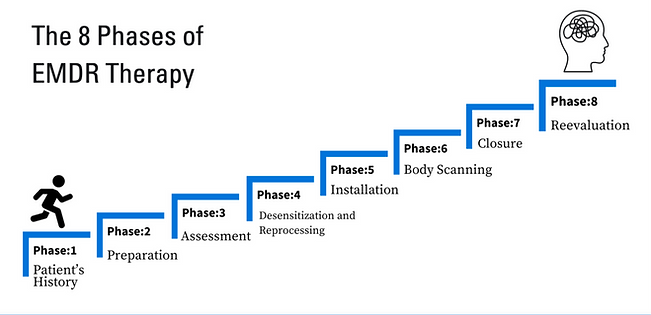
There are 8 Phases in EMDR Therapy - What are they? and what to expect.

EMDR (Eye Movement Desensitization and Reprocessing) therapy is a comprehensive and structured approach. Matt guides clients through eight distinct phases, ensuring a thorough and effective processing of distressing experiences. While the core of EMDR often involves bilateral stimulation (like eye movements), it's part of a broader, carefully designed therapeutic process.
Phase 1: History and Treatment Planning
This initial phase, typically spanning one to two sessions but potentially ongoing, is where Matt gathers a comprehensive understanding of your history and current challenges. He'll discuss the specific issues that led you to seek therapy, as well as the behaviors and symptoms you're experiencing.
Based on this information, Matt will collaborate with you to develop a personalised treatment plan. This plan identifies the specific targets for EMDR processing, including:
-
Past events that contributed to your current difficulties.
-
Present situations that cause you distress.
-
Key skills or behaviors you need to develop for your future well-being.
An important aspect of EMDR is that you don't need to recount disturbing memories in explicit detail. While some clients prefer to share specifics, others may offer a more general overview. For example, if Matt asks, "What event do you remember that made you feel worthless and useless?", you might simply say, "It was something my brother did to me." This level of information is often sufficient for Matt to identify and target the event for processing with EMDR.
Phase 2: Preparation
This phase typically takes between one and four sessions, though it may be longer for individuals with extensive trauma histories or certain diagnoses. A primary goal of this phase is to build a strong trusting relationship between you and Matt. While detailed disclosures aren't required, your ability to accurately report your experiences during the eye movements is crucial for effective processing.
During preparation, Matt will:
-
Explain the theory of EMDR and how it works.
-
Outline what to expect during and after sessions.
-
Teach you specific self-calming techniques to manage any emotional disturbance that might arise during or between sessions. These tools are invaluable for anyone, empowering you to decompress from life's inevitable stresses. Matt views himself as a facilitator, and open communication about your feelings and needs is key to achieving your therapeutic goals.
Phase 3: Assessment
In this phase, Matt will guide you to access each identified target in a controlled and standardized way for processing. It's important to note that "processing" in EMDR doesn't mean extensively talking about the event.
Here's how this phase typically unfolds:
-
You'll select a specific image or mental picture from the target event (identified in Phase 1) that best represents the memory.
-
You'll then choose a negative self-belief statement associated with the event (e.g., "I am helpless," "I am unlovable"). Even if you intellectually know it's not true, you'll focus on how it feels.
-
Next, you'll pick a positive self-statement you'd prefer to believe (e.g., "I am worthwhile," "I am in control"). This positive statement should reflect an internal sense of empowerment.
-
Matt will then ask you to rate how true this positive belief feels using the 1-to-7 Validity of Cognition (VOC) scale, where 1 is "completely false" and 7 is "completely true." It's crucial to rate based on how it feels, not just what you think.
-
You'll also identify any negative emotions (e.g., fear, anger) and physical sensations (e.g., tightness in the stomach) associated with the target. You'll rate the intensity of these disturbances using the 0-to-10 Subjective Units of Disturbance (SUD) scale, where 0 is "no disturbance" and 10 is "worst disturbance."
The ultimate goal of the subsequent EMDR phases is for your SUD scores to decrease while your VOC scores for positive beliefs increase.
Reprocessing: Phases 4, 5, and 6
For a single trauma, reprocessing is often accomplished within three sessions, with noticeable improvement typically observed within that timeframe. These phases build upon the groundwork laid in Phases 1 through 3, allowing Matt to effectively guide the comprehensive processing of targeted events. While eye movements are used here, they are one component of a sophisticated therapeutic process.
Phase 4: Desensitisation
This phase focuses on reducing the intensity of your disturbing emotions and sensations, as measured by your SUD ratings. As the targeted event is reprocessed, you may experience other memories, insights, or associations. This phase also provides an opportunity to identify and resolve similar past events connected to the target, allowing for deeper healing.
During desensitization, Matt will lead you in sets of eye movements, sounds, or taps, adjusting the focus as needed, until your SUD levels are significantly reduced (ideally to 0, 1, or 2). Matt will guide you through the different associations to the memory, working towards a complete resolution of the target.
Phase 5: Installation
The goal of this phase is to strengthen and deepen your positive self-belief that you identified earlier. For example, if you began with a negative belief of "I am powerless" associated with a childhood event, during desensitization, you would have processed the terror of that event and realized your current adult strength and choices.
In Phase 5, your positive cognition, such as "I am now in control," will be reinforced and "installed." Matt will measure how deeply you believe this positive cognition using the Validity of Cognition (VOC) scale, aiming for a score of 7 (completely true). EMDR cannot make you believe something that isn't appropriate; if you still need to learn new skills to fully feel in control, your VOC score will reflect that, perhaps reaching a 5 or 6 until those skills are acquired.
Phase 6: Body Scan
After the positive cognition is strengthened, Matt will ask you to bring the original target event to mind and notice if any residual tension remains in your body. If physical sensations are present, they are then targeted for reprocessing.
Research suggests that unresolved trauma can be stored in body memory, retaining negative emotions and physical sensations. As this information is processed, it can shift to narrative memory, and the associated body sensations and negative feelings dissipate. A successful EMDR session means you can recall the original target without experiencing any body tension, confirming that the positive self-beliefs are integrated beyond just an intellectual level.
Concluding Phases
Phase 7: Closure
This phase concludes every EMDR session, ensuring you leave feeling more regulated than when you started. If the processing of a traumatic target isn't completed in one session, Matt will equip you with various self-calming techniques to maintain a sense of equilibrium. You remain in control throughout the EMDR session, and it's essential that you continue to feel empowered outside of Matt's office.
Matt will also brief you on what to expect between sessions (e.g., continued processing, new material arising), how to use a journal to record experiences, and how to utilize calming techniques for self-soothing in your daily life.
Phase 8: Reevaluation
This phase begins every new session and is crucial for determining the long-term success of the treatment. While you may experience immediate relief with EMDR, completing all eight phases is as vital as finishing a full course of antibiotics. The reevaluation phase guides Matt in adapting your treatment plan as needed, ensuring comprehensive resolution of your challenges.
🌀 TeraTappers: How They Help in EMDR
TeraTappers provide bilateral stimulation (BLS) to support EMDR processing. They come in two forms: kinetic (vibrations in the hands) and audio (alternating tones through headphones). Both help the brain stay grounded while processing difficult memories.
✋ Kinetic (Vibration)
Kinetic TeraTappers gently alternate vibrations between the hands.
Clients mention it working for them:
-
Creates a steady, grounding rhythm
-
Helps keep one foot in the present while revisiting past memories
-
Offers a physical anchor when emotions feel intense
Simple explanation: “It’s like holding onto something steady while your mind moves through the memory.”
🎧 Audio (Alternating Tones)
Audio TeraTappers use left‑right tones through headphones.
Clients mention it working for them:
-
Less physical, more subtle
-
Supports internal focus and imagery
-
Feels spacious and calming
Simple explanation: “It’s like listening to gentle waves moving from side to side.”

What issues can I use EMDR for?
Scientific research has established EMDR as effective for post traumatic stress disorder (PTSD). Clinicians have also successfully used EMDR as a treatment component in the management of:
-
Depression
-
Anxiety
-
Panic attacks
-
Personality disorders
-
Complicated grief
-
Dissociative disorders
-
Pain disorders
-
Body dysmorphic disorders
-
Eating disorders
-
Sexual or Physical abuse
-
Performance anxiety
-
Stress reduction
-
Disturbing memories
-
Phobias
Redlands Counselling Service provides Counselling to Birkdale, Wellington Point, Capalaba, Manly, Ormiston, Wynnum, Cleveland, Thorneside, Thornlands, Wakerley, Redland Bay, Mount Cotton, Chandler, Sheldon, Victoria Point, and other suburbs across Brisbane.